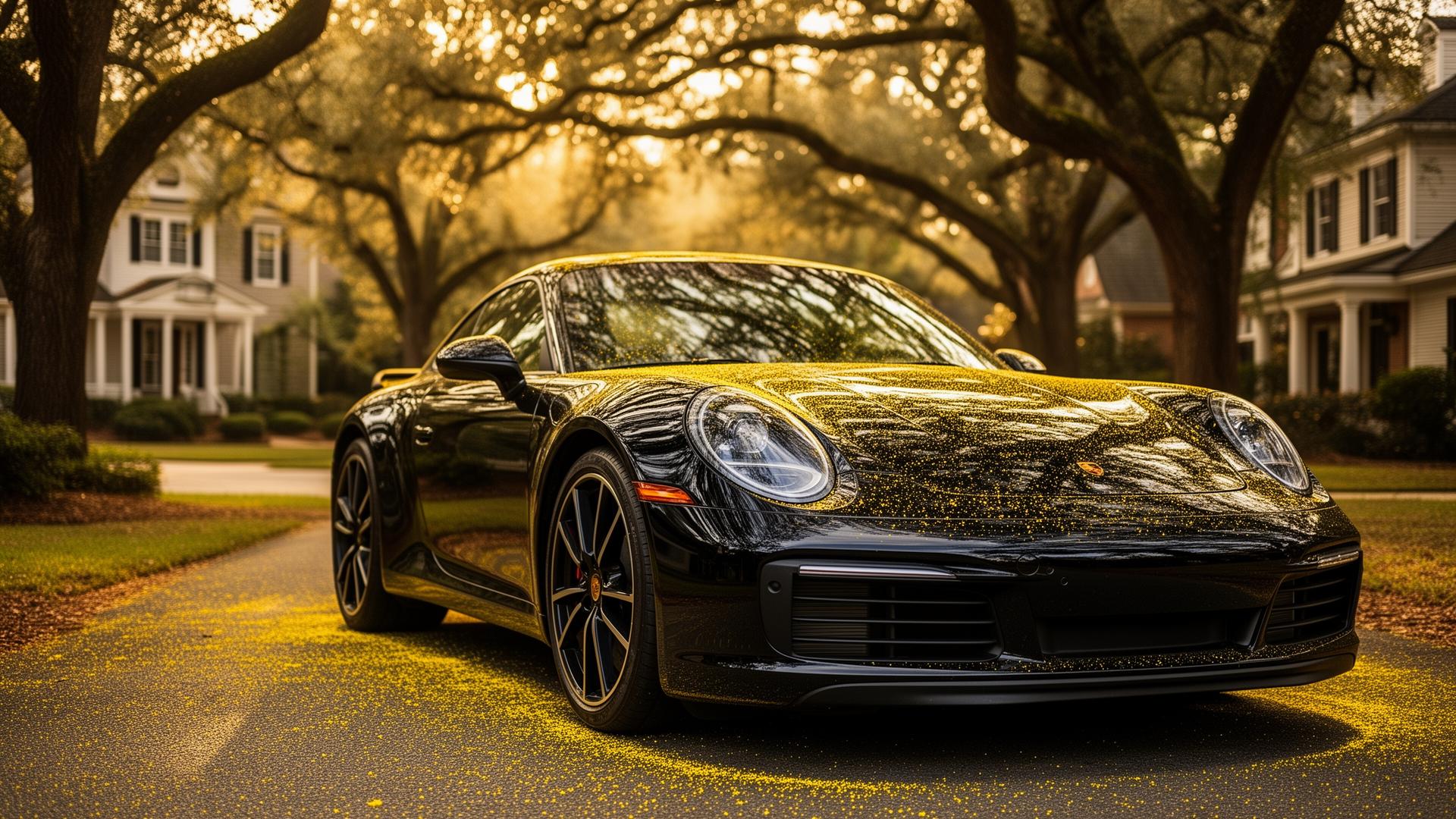
Why Pollen and Tree Sap Are Destroying Luxury Car Paint in Atlanta
Every spring I get the same call from clients across Alpharetta, Roswell, Milton, Cumming, and Buckhead: "My car is yellow again—how bad is it really?" The honest answer is that Atlanta's pollen and tree sap quietly do more damage to luxury car paint than almost anything else our climate throws at a vehicle.
I've spent years caring for Porsche GT3 RS builds, Ferraris, and serious collector vehicles in this region. The cars that look flawless years later have one thing in common: their owners take our heavy pollen season seriously. The ones that need paint correction almost always waited too long.
How Pollen Actually Damages Luxury Car Paint
People assume pollen is harmless because it looks like soft dust. It isn't. Pine and oak pollen are acidic, and once they bond to clear coat—especially in our humid Atlanta mornings—they begin etching the surface within hours.
What Pollen Does to Clear Coat
- •Acidic etching — Morning dew activates the acidity in pollen. The result is faint outlines and dull patches that won't wash off.
- •Clear coat dulling — A thin pollen film acts like fine sandpaper the moment anyone wipes it with a dry towel.
- •Trim and seal staining — Pollen embeds into rubber window seals and matte trim, where it's nearly impossible to fully remove.
Why Tree Sap Is Even Worse
Tree sap is the silent killer of paint finishes in tree-heavy neighborhoods like Milton, Roswell, and the older Buckhead streets. Sap starts soft, but as Atlanta's heat works on it, it hardens into a resin that physically bonds to the clear coat. Within a few weeks—sometimes days under direct sun—it etches a permanent ring into the paint.
I've pulled cars into our care that had visible sap craters on otherwise spotless Porsche paint. By the time the owner noticed, machine polishing was the only option. On collector and single-stage finishes, even that has limits.
Why Waiting Too Long Causes Permanent Damage
The most common pattern I see: an owner decides to "wait until pollen season is over" before booking a detail. By then, six to eight weeks of contamination have cycled through wet mornings and 80-degree afternoons. The contamination is no longer sitting on the paint—it's bonded into it.
At that point a maintenance wash isn't enough. We're looking at iron decontamination, clay treatment, and often a single-step polish to restore clarity. That's an avoidable cost.
Why Garage Parking Doesn't Fully Protect You
Garage-kept clients are often the most surprised. The reality is simple: pollen travels indoors with the car. Every time you open the garage door in March or April, ambient pollen settles on the paint. Tree sap drips during the drive home and continues curing inside the garage.
I've inspected garage queens in Cumming and Alpharetta with measurable contamination on horizontal panels despite never being parked outside. Garage storage slows the problem—it doesn't eliminate it.
How Often to Detail Your Car During Pollen Season
From mid-February through May, Atlanta's pollen counts routinely cross into the "extremely high" range. During this window I recommend our clients move to a tighter cadence:
Daily-Driven Luxury Vehicles
Every 2 weeks
Pollen reaccumulates within days. A consistent two-week cycle prevents bonding and keeps clear coat clarity intact.
Weekend Cars & Garage-Kept Collectors
Monthly during pollen season
Even if the car barely moves, ambient pollen exposure justifies a monthly maintenance visit through May.
After Any Sap Contact
Within 48 hours
Sap should never be allowed to fully cure on luxury paint. Prompt safe removal prevents etching that polishing can't fully reverse.
For clients who want this handled without booking each visit individually, our ongoing maintenance plan keeps vehicles on the right cadence year-round.
What I See in the Field Across North Atlanta
The differences between neighborhoods are real. Older sections of Buckhead and Roswell have dense oak canopies—heavy sap, heavy pollen. Newer Cumming and Milton developments tend to have more pine, which produces enormous yellow pollen drops in spring. Alpharetta sits somewhere in between, with plenty of mature trees lining the prestige neighborhoods.
The owners who treat pollen season as a non-event are the same ones I see two years later asking why their paint still looks new. It's not luck—it's cadence.
How to Protect Your Car From Pollen and Sap
- •Never dry-wipe pollen with a towel—rinse first, always.
- •Address sap within 48 hours using a paint-safe solvent, not a fingernail.
- •Consider a fresh ceramic coating—pollen and sap release far easier from coated surfaces.
- •Schedule professional maintenance washes on a fixed cadence through May.
For more on cadence specifically, see our deeper guide on how often you should detail a luxury or classic car.
Protect Your Paint This Pollen Season
We bring concierge-level luxury mobile car detailing directly to your driveway across Atlanta, Alpharetta, Roswell, Milton, Cumming, and Buckhead.